
A startup plan is a working hypothesis, not a guarantee.
In early-stage companies, timelines shift, launches underperform, hires miss, and funding takes longer than expected. That does not automatically mean the goal is wrong. Strong founders know how to keep the vision steady while changing the path. The skill is not sticking to the original plan at all costs. The skill is adapting without losing direction.
A lot of founders think the hard part is making the plan.
It is not.
The hard part is what happens after the plan stops working.
This is something I want to say clearly:
Your first plan will probably fail. Your second one might too.
That's not pessimism. That's reality.
Over the years I've seen too many founders panic when the original plan breaks. Funding takes longer. A launch underperforms. A key hire doesn't work out. The market shifts.
And suddenly, doubt sneaks in.
Most founders treat their plan and their goal as the same thing.
So when the plan cracks - and it will - it feels like the whole vision is crumbling. They freeze. They over-correct. Or worse, they quit.
"The goal stays locked in.
The path? That's flexible."
That's the distinction that separates founders who make it from those who don't.
How to Switch Gears Without Losing Direction
If you're reading this in Q2 and your original plan has already cracked - good.
You're exactly where you need to be.
The question now isn't "what went wrong." It's "what's next."
- Name what's actually broken
Is it the channel? The pricing? The timing? The target customer? Be specific. If you are vague, your pivot will be vague as well.
Precision leads to progress. - Separate the signal from the noise
One bad month isn't a death sentence. But three months of the same problem is a pattern. Look at the data, not just the feeling. What is the market actually telling you? - Find out what went wrong - from the source
Talk to the people who said no. The investors who passed. The customers who churned. The leads who ghosted. Their feedback isn't rejection - it's intel. Use it to recalibrate. - Move fast, but move deliberately
Panic rarely works to your benefit. You're not throwing darts at a board. You're making an informed adjustment based on what you've learned. That's the difference between reacting and adapting. - Communicate the shift clearly
To your team. To your investors. To yourself. "We tried X, we learned Y, now we're doing Z." That's not failure. That's leadership.
What Makes This Possible
The founders who navigate setbacks best aren't the ones who never face them. They're the ones who hit them running.
When you're too attached to the how, every obstacle feels like an attack on who you are. When you're anchored to the why, obstacles become problems to solve.
This isn't about being detached. It's about being focused on the right thing.
"Your strategy can change.
Your conviction doesn't have to."
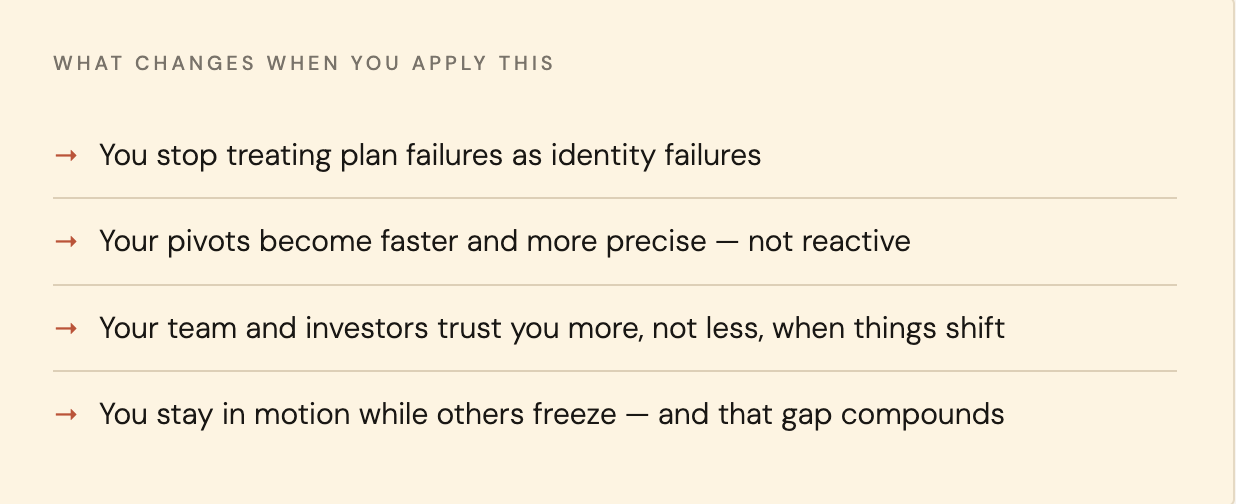
Bottom Line
If your Q1 plan didn't survive, you're not behind. You're learning.
The founders who win aren't the ones with perfect plans. They're the ones who keep moving toward the goal even when the path disappears.
Funding didn't come through? Find another way. Launch flopped? Learn and relaunch. Strategy isn't working? Pivot the approach, not the vision.
Stay stubborn about your vision.
Stay flexible about your tactics.
Your plan might change 10 times this year. Your goal doesn't have to change once.
Until next time, keep building.
P.S. - If you're navigating a pivot right now and want a sounding board, reply to this email. I read every message. Sometimes the clearest next step comes from naming it out loud to someone who's seen it before.