
One thing that has struck me over the past few years is how obsessed the startup world is with HOW.
How do we raise funding?
How do we build the MVP?
How do we scale faster?
How do we sell to customers?
How do we get investor attention?
Everyone is Chasing the Perfect HOW
And I get that.
The HOW feels practical.
It feels concrete.
It feels like progress.
But the HOW is not what makes people lean in.
Because the HOW changes constantly.
What worked for fundraising a year ago might not work today.
What worked for customer acquisition in one market might fail in another.
What worked for one founder might be completely wrong for you.
The HOW is useful.
But it is not the foundation.
The real driver is your WHY.
Founders Start Too Late in the Story
Here is where I see founders get stuck.
They start their pitch at the product.
Then they move to the features.
Then the roadmap.
Then the go-to-market.
Then the business model.
Then the “how we will scale” slide.
And technically, nothing is wrong.
But emotionally, nothing has landed.
The investor understands what you are building.
But they do not yet understand why it matters.
And that is a problem.
Because before investors believe in your product, they need to believe in the problem.
Before they believe in your strategy, they need to believe in your insight.
Before they believe in your numbers, they need to believe there is a real shift happening in the market.
The biggest pitch mistake is explaining the plan before creating belief.
That is how a pitch becomes informative but forgettable.
What Steve Jobs Understood About Belief
Steve Jobs said something every founder should understand before walking into an investor pitch:
“Marketing is about values.”
Not features.
Not specs.
Not technical superiority.
Values.
When Jobs introduced Apple’s Think Different direction in 1997, his point was simple:
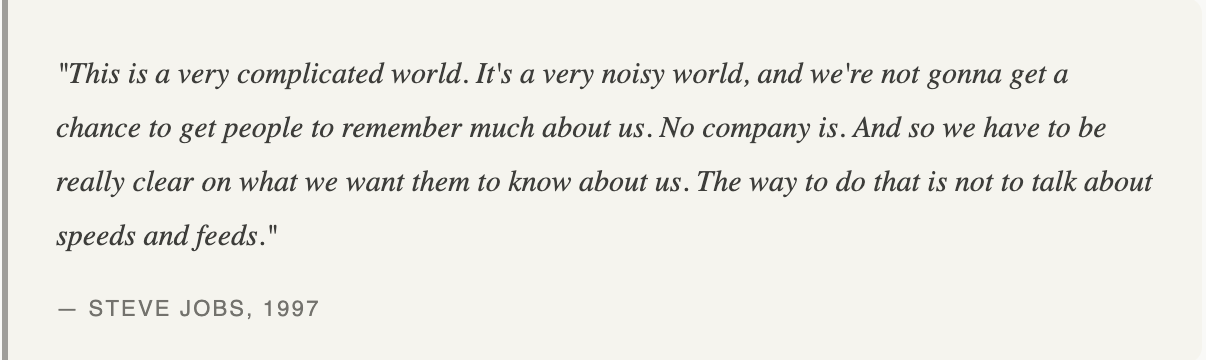
That is exactly where many startup pitches go wrong.
Founders try to make people remember everything.
And that is definitely not possible with the noisy world we are having today.
A strong pitch does not make people remember everything.
But - it makes them remember the right thing.
Jobs used Nike as an example. Nike sells shoes, but Nike does not lead with shoes. Nike leads with what it believes in: athletes, performance, discipline, ambition, and the human drive to push further.
That is why people feel something when they think of Nike.
And this applies directly to your pitch.
You are not just presenting a company.
You are asking people to believe that a problem matters, that your team can solve it, and that now is the time to act.
That is belief transfer.
(the video with Steve Jobs - definitely worth watching)
The WHY-Before-HOW Pitch
The strongest investor pitches build three layers of belief before going deep into tactics.
Step 1: Build Belief in the Problem
Do not start with your solution.
Start with the pain.
What is broken?
Who feels it?
What does it cost them?
Why is the current way no longer good enough?
Too many founders describe the problem like an observation.
But a strong pitch frames the problem like pressure.
And nothing is as memorable as a great story.
Step 2: Build Belief in You
Investors do not only invest in markets.
They invest in founders with a clear edge.
So answer the question directly:
Why you?
Why are you closer to this problem than others?
What have you seen that others have missed?
What experience, insight, data, network, or customer access gives you an advantage?
This does not mean you need to sound arrogant.
It means you need to show your right to win.
Too many founders hide their strongest founder-market fit behind generic team slides.
Instead tell me what makes this team unusually suited to this problem.
That is what makes investors lean in.
Step 3: Build Belief in the Timing
A good idea at the wrong time is still hard to fund.
Investors need to understand why this opportunity is opening now.
What has changed? Customers? Tech? Regulations?
This is where you show momentum.
Not hype.
Momentum.
The HOW Still Matters - But It Comes Second
Let me be clear.
The HOW matters.
Your go-to-market matters.
Your roadmap matters.
Your business model matters.
Your numbers matter.
Your execution plan matters.
It all matters!
But they land differently when the WHY is already clear.
When investors understand the problem, they listen to your solution differently.
When they understand your edge, they evaluate your plan differently.
When they understand the timing, they see your traction differently.
The WHY gives context to the HOW.
Without it, your pitch becomes a list of actions.
With it, your pitch becomes a story people can believe in.
Investors Need Your WHY Before They Care About Your HOW
When your WHY is clear, you can:
-
Make investors understand the problem faster
-
Create a stronger opening hook
-
Show why your team has a real edge
-
Make your timing feel urgent, not random
-
Turn your pitch from explanation into conviction
-
Help customers, talent, partners, and investors understand why they should care
So before you rewrite your roadmap slide again…
Before you chase another fundraising tactic…
Before you search for one more pitch deck template…
Pause.
Ask yourself:
Why does this problem truly matter?
Why are we the ones to solve it?
Why does the world need this now?
Because the world is noisy.
Your investor pitch cannot be.
Build belief first.
The HOW will follow.
Thats all for today.
See you next week!